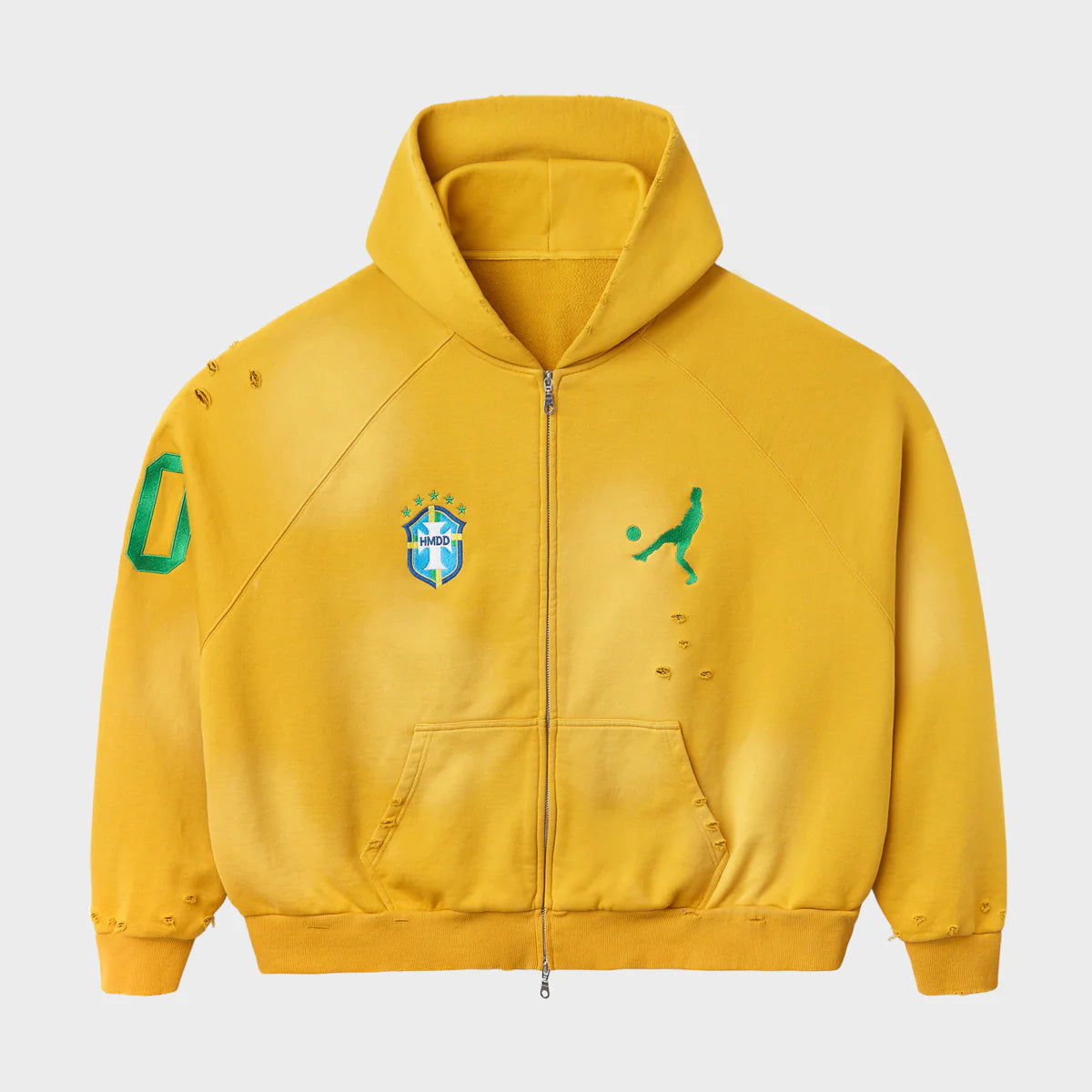
HMDD Collaborations: Their Impact on the Brand’s Identity
HMDD, short for Happy Memories Don’t Die, has built its name on a philosophy rather than a logo. The brand treats clothing as a vessel for nostalgia, and every collaboration it enters becomes a test of whether that idea can survive contact with another creative voice. When two brands merge visions, one of them usually bends. With HMDD, the bending tends to happen carefully, because the phrase “happy memories don’t die” is not just a tagline — it is the entire reason customers return. Collaborations force the label to answer a harder question than “what does this look like?” It has to answer “does this still feel like us?” That tension is exactly why HMDD’s partnerships matter more than a typical streetwear crossover.
Grabbing borrowed spotlight is often the point behind most fashion collabs exist. A lesser-known brand partners with a bigger name, sees a burst in traffic, and walks away. HMDD’s approach feels different in reality. HMDD generally tends to choose partners who from the outset resonate on the same emotional wavelength — wistful, rooted in memory, subtly defiant — rather than pursuing whichever name is making the most noise. Because of that selectiveness, the brand identity holds together across releases — and it’s worth examining piece by piece.
Explaining Why Joint Projects Serve as a Identity Stress Test
A label’s identity proves easiest to defend when it works independently. Material decisions, print positioning, and fit decisions all stay inside one team’s control. Once a second creative partner steps in, compromises start piling up. HMDD clothing has built recognition around specific signals: distressed graphics, oversized silhouettes, and text treatments that reference memory, loss, and time. An outside collaborator favoring a more polished, commercial style could readily water down those signals into something more generic.
This is where discipline emerges as a calculated strength. Voices across the HMDDLA community have noted hmmdla.org/shorts-sweatpants that collaboration pieces preserve the brand’s essential design identity: the same fabric weight, the same worn-in print technique, and the same emotionally charged titling carried across tags and inserts. That consistency isn’t accidental. This implies an underlying principle: the collaborator can influence color or silhouette, but that core emotional current is left intact.
Consider the alternative. If HMDD released a collab hoodie with bright, glossy branding and zero reference to its usual themes, longtime buyers would notice within seconds. The brand’s audience isn’t drawn in by trend-chasing; they’re drawn in by specificity. A single misstep — one collection that feels like merchandise rather than memory — could cost more trust than any short-term sales bump would repay.
HMDD’s Own Creative Approach: The Insights The Brand’s Partnerships Uncover
Creative patterns that might otherwise go unnoticed get brought into focus by every partnership. Any time HMDD partners with someone outside the brand, certain elements repeat across nearly all output: heavyweight cotton foundations (usually in the 280–400 GSM range for hoodies and sweatshirts), loose-fitting boxy cuts, and hand-distressed or re-dyed finishes that give each piece a broken-in quality rather than a brand-new one. HMDD’s sweatpants line makes the pattern most obvious — relaxed tapering, elasticated rib endings, and a fabric hand-feel that favors comfort over crisp shaping.
HMDD shorts follow a similar logic. Rather than letting shorts play second fiddle, HMDD applies the identical worn-finish methods and typography choices seen across jackets and hoodies, helping a full seasonal drop stay consistent rather than fragmented. Such uniformity spanning hoodies, sweatpants, shorts, and tees — hoodies, sweatpants, shorts, tees — helps explain why shoppers specifically look up “best hmdd clothing” instead of accepting a generic streetwear substitute.
- Textile heft stays dense and weighty, even in hot-season pieces like shorts.
- Type styling leans on scrawled or weathered-stencil styles instead of crisp sans-serif labeling.
- Color palettes lean toward washed-out blacks, softened greys, and subdued natural tones over saturated brights.
- Print imagery nod to memory, time, and impermanence instead of pure logo placement.
When a collaborator enters this world, they’re essentially asked to fall in line with HMDD’s aesthetic rather than impose their own. It’s a bigger demand than it seems, and that’s the reason not every suggested alliance ends up released.
Why Selective Collaboration Makes Business Sense
Streetwear’s market logic reward scarcity and punish overexposure. A brand that teams up indiscriminately eventually collaborates with no one memorably. HMDD’s drop schedule seems to prioritize limited quantities and occasional joint releases rather than a constant stream of co-branded product. That pacing does two things at once: it preserves the feeling of exclusivity, and it allows the design team the time needed to ensure each collaboration still reads as unmistakably HMDD.
Worth noting too is the pricing strategy at play. Collaboration pieces in streetwear typically carry a premium over standard catalog items — commonly priced 15–30% higher — due to greater manufacturing complexity, smaller runs, or co-branding expenses. Customers researching an “hmdd review” before buying often flag price-to-quality ratio as a deciding factor, so a collaboration that hikes the price but not the perceived skill behind it invites criticism instead of approval.
Because of this the most astute fashion joint ventures operate more as shared research-and-development efforts than promotional gimmicks. Both teams combine their methods — maybe one contributes a dye process, the other contributes a silhouette — and the result should feel earned rather than slapped together. When that balance works, each fanbase ends up embracing the other label. If it doesn’t, both fanbases feel like an afterthought.
Weighing Different Collaboration Strategies
To understand where HMDD positions itself relative to common streetwear collaboration playbooks, it helps to weigh a few common approaches applied across the industry in 2026. The chart that follows lays out three broad collaboration patterns seen in the wider streetwear scene, not tied to specific named partners.
| Type of Collaboration | Core Aim | Standard Batch Size | Threat to Brand Character |
|---|---|---|---|
| Repeated co-branding | Maximize visibility and foot traffic | Large, ongoing batches | High — brand character weakens with too much visibility |
| One-off hype drop | Brief sales jump | Extremely scarce, single run | Moderate — effect dissipates once trend passes |
| Carefully-chosen, values-aligned partnership (HMDD’s characteristic pattern) | Solidify core identity while reaching adjacent audiences | Sparing, infrequent | Low — partner conforms to brand language rather than replacing it |
It’s in that third category that HMDD’s partnerships tend to settle. There’s little sign the brand wants to saturate its calendar with joint releases. Instead of that, each partnership looks crafted to answer a particular creative question — a new fabric process, an fresh color direction, a fresh take on distressing — while leaving the sentimental center of “happy memories don’t die” fully intact.
What This Means for Shoppers in 2026
For those weighing HMDD against other up-and-coming streetwear names in 2026, collaborations offer a valuable litmus test. If a co-branded item still feels distinctly HMDD — same fabric weight, same worn typography, same emotional resonance — that signals the brand’s identity is resilient enough to survive growth. If later drops start blurring into whoever’s name is attached, that amounts to a warning sign worth watching.
Anyone looking into HMDD sweatpants, HMDD shorts, or a collaboration release should keep an eye on a few concrete details before buying: fabric weight specified in the product description, whether sizing runs true-to-size or intentionally oversized, and whether the piece is part of a numbered or limited run. These details are more important in collaboration releases than in regular catalog drops, since collaboration pricing usually sits higher and expectations increase accordingly.
At the end of the day, HMDD’s collaborations serve as identity checkpoints rather than pure marketing events. Every partnership tests whether HMDD can expand its audience without sacrificing the distinct, nostalgia-driven feel that earned it a following in the first place. The pattern so far points to a brand that cares more about guarding its voice than grabbing every spotlight on offer — and for a label built wholly around emotional resonance, that discipline may be its most valuable asset heading further into 2026.